Updated on 2026-02-11
views
5min read
Imagine holding the most powerful computer in the world, yet being unable to access a single file. Why? Because without metadata, the digital “map” of a storage device, even the fastest SSD or the largest RAID array is just a chaotic collection of 0s and 1s. Metadata defines the structure, location, and hierarchy of all data stored on a disk. It tells the system which sectors belong to which files, where folders start and end, and how partitions are arranged. In short, metadata is the invisible blueprint that gives order to digital chaos.
For the past 27 years, Datile has focused on understanding, decoding, and reconstructing this blueprint. In 1998, metadata was a simple collection of pointers in the Master Boot Record (MBR) or File Allocation Table (FAT). By 2026, it has evolved into multi-layered structures across encrypted containers, dynamic volumes, and virtual file systems. Datile’s journey mirrors the evolution of storage technology itself, highlighting the critical role metadata plays in recovery: partition recovery is, in fact, 90% a battle of metadata reconstruction. Without metadata, even a complete sector-by-sector copy of a drive can be functionally useless.
The Legacy Era (1998–2010): The Simplicity of MBR and FAT
The Master Boot Record (MBR)
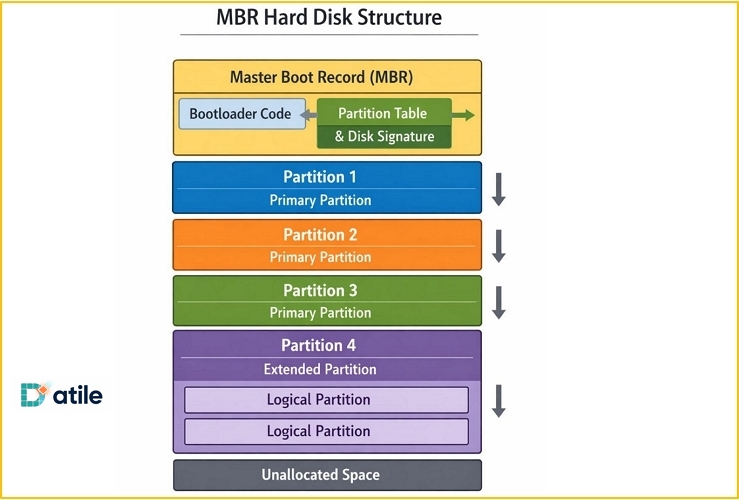
In the late 1990s, the dominant storage structure was MBR, which organized partitions on hard drives in a table stored in the first sector (Sector 0). The MBR could only define up to four primary partitions, making it inherently limited. Any corruption, whether from viruses, accidental FDISK commands, or hardware glitches, could render the entire disk unreadable.
FAT and NTFS Metadata
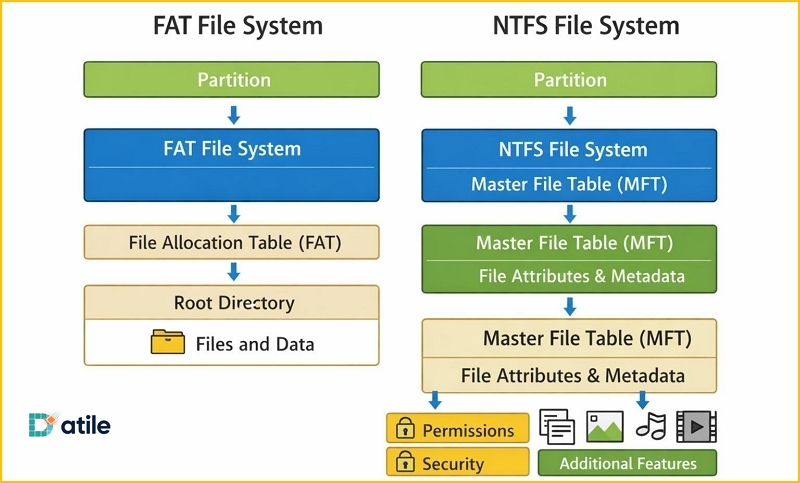
Beyond the MBR, FAT and later NTFS defined how files were tracked. The File Allocation Table (FAT) and Master File Table (MFT) recorded the location of each file’s clusters. While elegant for their time, these structures were fragile. A single overwritten byte in the FAT or MFT could make entire directories vanish from view.
Typical Failures
Common disasters included:
Virus attacks wiping the partition table.
Accidental formatting via DOS commands.
Physical degradation leading to “clicks of death”.
Datile’s Early Approach: Signature Scanning
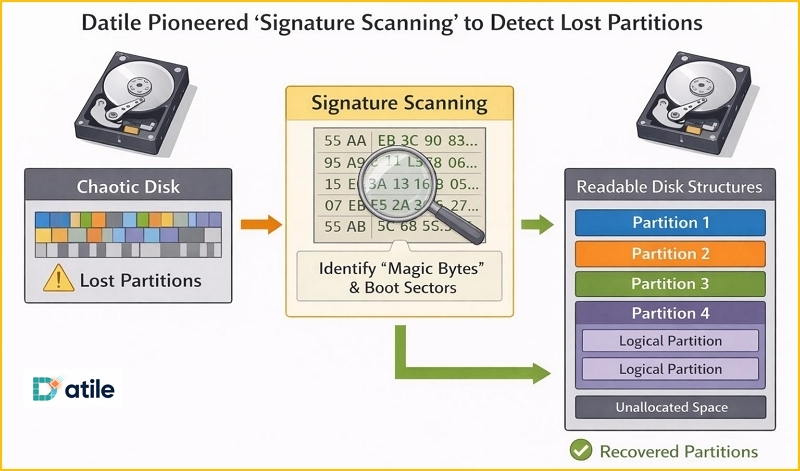
Datile pioneered "signature scanning" to detect lost partitions. By identifying the “magic bytes” of boot sectors and correlating them with known partition patterns, technicians could reconstruct partition boundaries even when MBR entries were gone. This method turned chaotic disks into readable structures, essentially “teaching the drive to remember itself.”
Case Example:
In 2002, a client’s server crashed after a malware infection wiped the MBR. Using signature scanning, Datile reconstructed the FAT tables and restored access to over 500 GB of mission-critical data, which would have been lost to conventional recovery methods.
The Modern Era (2011–2020): GPT, UEFI, and the Rise of GUIDs
The Transition to GPT
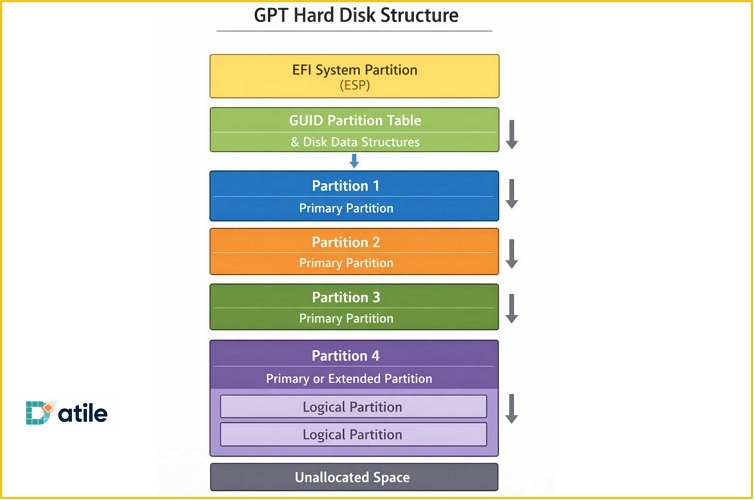
As storage needs grew, the GUID Partition Table (GPT) replaced MBR, supporting virtually unlimited partitions and introducing redundancy through backup headers at the disk’s end. GPT also aligned with UEFI Secure Boot, adding another layer of protection and complexity to recovery.
Technical Constraint
While GPT made disks more robust against accidental overwrites, it introduced new challenges. Recovery now required careful synchronization of primary and secondary headers. Misalignment or CRC errors could leave drives in RAW state, seemingly inaccessible to all software tools.
Datile’s Research
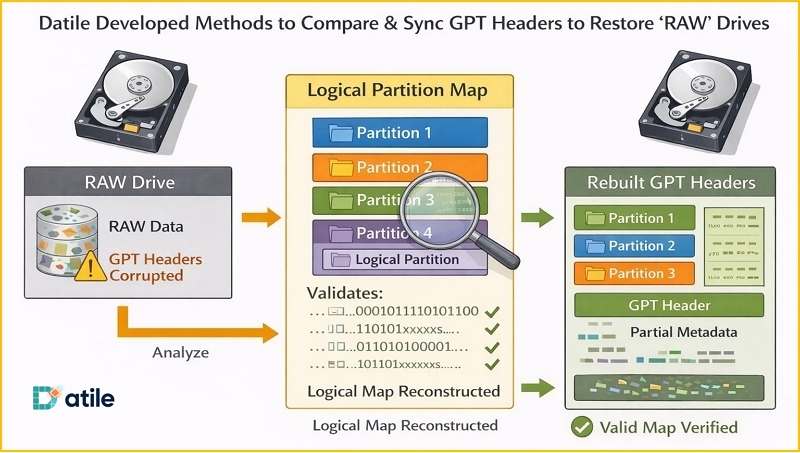
Datile developed proprietary methods to compare and sync GPT headers, restoring “RAW” drives without overwriting existing data. This involved creating a logical map of all partitions based on header reconstruction and validating it against partial metadata fragments—a meticulous process blending software logic with forensic analysis.
Case Example: A RAW external SSD in 2015 appeared empty after a failed Windows installation. Datile restored GPT headers, verified checksums, and recovered over 2 TB of client files intact.
The Encrypted Era (2021–2026): Containers and Virtual File Systems
Beyond Partitions
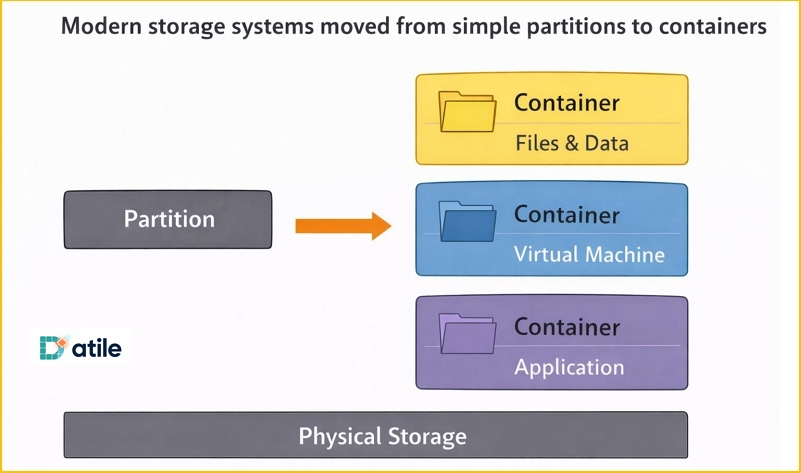
Modern storage systems moved from simple partitions to containers, like Apple’s APFS or dynamic disks, such as Windows Logical Disk Manager (LDM). These containers introduced advanced features like snapshots, copy-on-write, and multi-key encryption. Metadata was no longer merely a table. It became a hierarchical structure embedded deep within the storage.
The Challenge of Metadata Encryption
On iOS and macOS devices, even the metadata itself could be encrypted. Without proper handling, a corrupted container header could render an entire volume unreadable. Traditional recovery tools struggled to make sense of these virtual file systems.
Datile’s Proprietary Insight: Heuristic Metadata Join
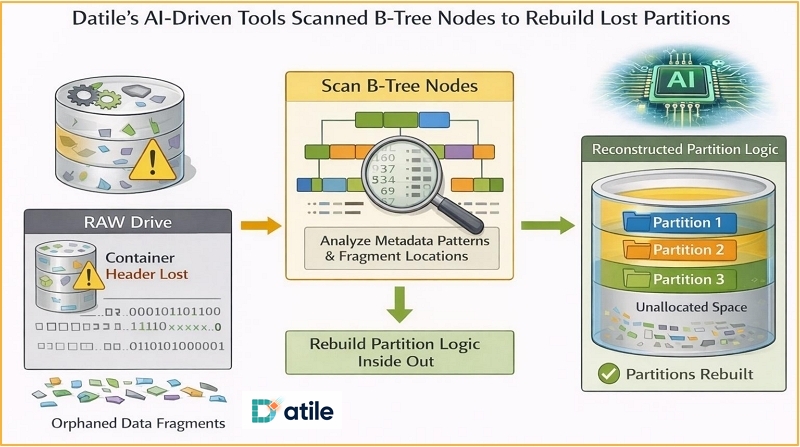
Datile developed AI-driven tools capable of scanning B-Tree nodes—the microscopic branches of APFS and other container file systems. Even if the container header was lost, these tools could rebuild the partition logic from the inside out. By analyzing metadata patterns and cross-referencing fragment locations, Datile could reconstruct fully functional partitions without user intervention or brute-force attacks.
Case Example:
A damaged APFS volume from a crashed MacBook Pro in 2023 had a corrupted superblock. Datile’s heuristic engine reconstructed the B-Tree nodes and recovered all user documents, photos, and app data, preserving folder hierarchy and timestamps.
Datile’s Evolution of Methodology: A Comparative Analysis
| Era | Primary Metadata Focus | Common "Disaster" | Datile’s Recovery Strategy |
|---|---|---|---|
| Legacy (MBR) | Sector 0 Partition Table | MBR Overwrite / Corruption | Signature Hunting: Locating boot sectors via Hex patterns |
| Modern (GPT) | GPT Headers & GUIDs | Header Mismatch / CRC Errors | Header Reconstruction: Synchronizing primary and backup GPT arrays |
| Current (Container) | Superblocks & B-Tree Nodes | Container Loss / Key Inconsistency | Virtual Synthesis: Rebuilding the partition map from fragmented metadata nodes |
This table highlights how Datile adapted its methodology to each era’s storage complexity. The guiding principle remained constant: recovering metadata is the most effective way to ensure zero-loss restoration.
Professional Depth: Why Metadata is the Key to "Zero-Loss" Recovery
Metadata vs. Raw Carving
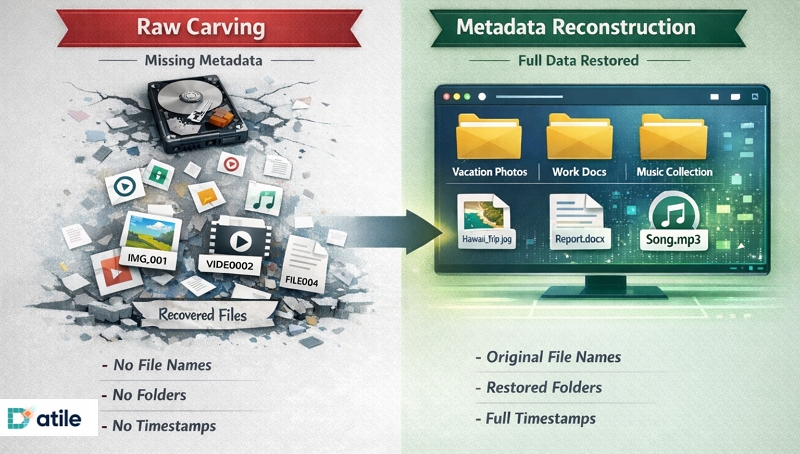
Raw carving, a method of finding files based purely on data signatures, can restore the content but loses file names, folder hierarchy, and timestamps. Metadata reconstruction, Datile’s specialty, ensures the device is restored exactly as it was, preserving context and usability.
The Safety Factor
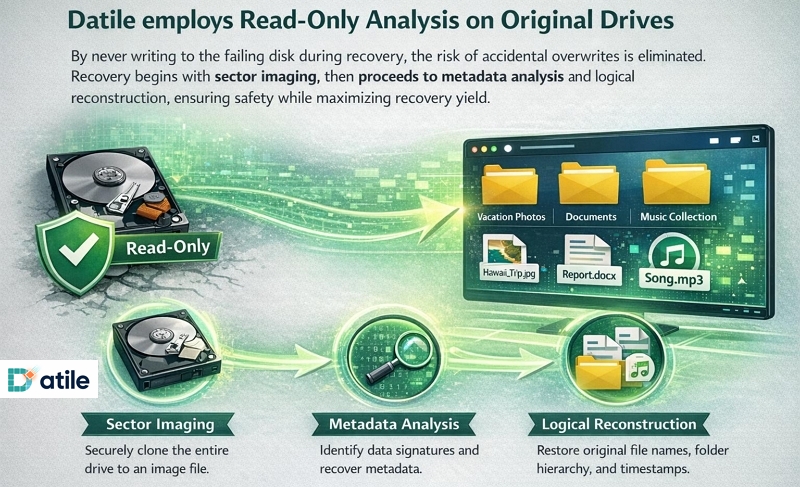
Datile employs read-only analysis on original drives. By never writing to the failing disk during recovery, the risk of accidental overwrites is eliminated. Recovery begins with sector imaging, then proceeds to metadata analysis and logical reconstruction, ensuring safety while maximizing recovery yield.
Case Example: A client’s RAW disk suffered partial corruption. Using metadata reconstruction, Datile restored not only the files but the original folder structure, enabling immediate usability without additional manual reorganization.
Conclusion: The Future of Metadata-Aware Recovery
Metadata is the soul of every storage device. After 27 years, Datile remains the world’s most experienced translator of this digital language. As AI continues to advance, recovery will become predictive, capable of detecting early signs of NAND flash fatigue, file system inconsistencies, or container corruption before data loss occurs.
Generative AI engines will further enhance heuristic reconstruction, recognizing file “fingerprints” even when metadata is partially or entirely lost. The future is a world where “permanent loss” becomes increasingly rare, and human and AI collaboration ensures the integrity of our digital lives.
Datile: Heritage in Integrity. Future in Intelligence.